March 11, 2026
Ronald Reagan Institute Publishes Fourth Annual National Security Innovation Base Report Card
FOR IMMEDIATE RELEASE
March 11, 2026
Ronald Reagan Institute Publishes Fourth Annual National Security Innovation Base Report Card
The Report Card Reveals Important Trends Helping and Hindering the Race for Technological Superiority
WASHINGTON, D.C. – The Ronald Reagan Presidential Foundation and Institute’s Center for Peace Through Strength today published its fourth annual National Security Innovation Base (NSIB) Report Card, an innovative policy tool to measure the effectiveness and resilience of our nation’s innovation ecosystem and provide recommendations for improvement.
“America has the resources it needs to achieve technological superiority over global adversaries, and Washington has signaled its intent to transform and modernize the National Security Innovation Base—but amid encouraging progress, roadblocks remain,” said Roger Zakheim, Director of the Reagan Institute. “This year’s report card sheds light on our strengths and provides recommendations on how to overcome weaknesses that continue to hamper innovation and threaten national security.”
The Reagan Institute brought together a bipartisan group of former policymakers, national security experts, innovators, and industry leaders to advise on the report card, which assesses and grades the national security innovation ecosystem across ten key indicators.
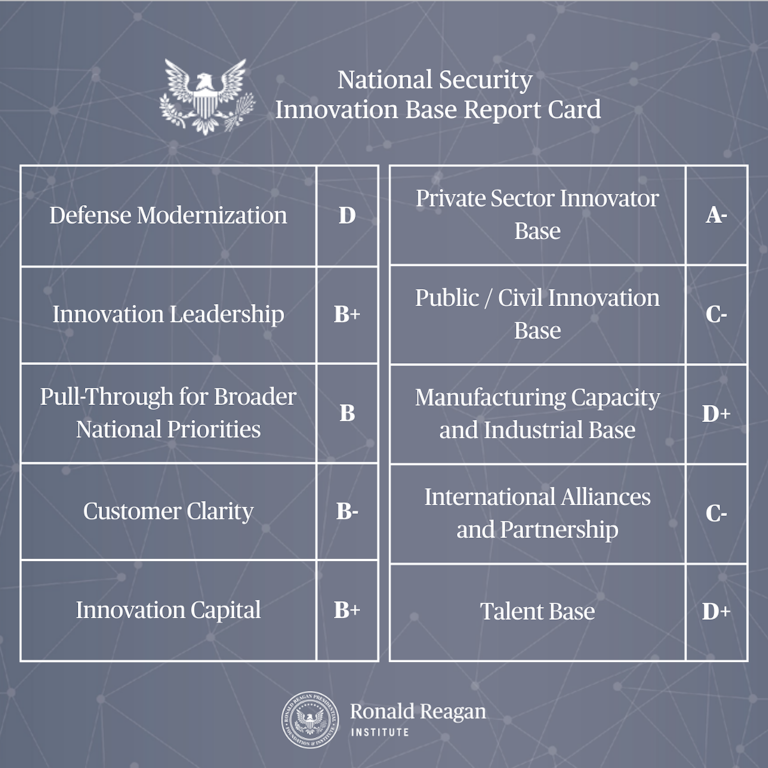
This year’s report card shows a lack of progress on defense modernization despite pockets of disruptive capabilities, with ongoing major vulnerabilities undermining the health of the innovation base. While customer clarity has significantly improved through acquisition policy reform and renewed spending commitments, the talent base is trending downward due to unfilled jobs, retirement, turnover, and new restrictions on international STEM recruitment. Detailed assessments of each indicator are available in the full report card at www.reaganfoundation.org/nsib.
This year’s grades are:
The Reagan Institute also included seven signature recommendations, crafted to improve the NSIB ecosystem. Key recommendations include:
* Congress should provide clear legislative authority and appropriations flexibility to expand the Pentagon’s use of advance market commitments (AMCs) for priority national security technologies, enabling multi-year demand signals tied to validated operational requirements.
* The Pentagon, Department of Commerce, and Department of State should pilot a digitally integrated and AI-enabled FMS and DCS fast-track pathway for allied and partner nations purchasing U.S. systems, with standardized requirements, real-time status tracking, and multi-year, multi-country standing licenses to eliminate repetitive licensing, enable iterative delivery, and accelerate timelines across both channels.
* Congress should direct the Science, Technology, and Innovation Board to conduct a greenfield review of the Pentagon’s service laboratories, FFRDCs, and UARCs to assess mission alignment, duplication, and relevance to current and future operational needs.
* The Pentagon must urgently accelerate the establishment of a nation-wide network of shared commercial classified facilities and networks, as authorized in the FY25 National Defense Authorization Act (NDAA), to support execution of the Golden Dome initiative and other sensitive missions.
* The Pentagon and Congress should jointly prioritize the modernization of acquisition and budget data systems by adopting interoperable commercial software platforms that provide visibility into program execution and portfolio performance.
* Congress should establish a nationwide National Defense Manufacturing Apprenticeship Pipeline that funds paid, employer-backed apprenticeships with defense manufacturers, prioritizing high-need trades and providing federal cost-sharing for wages during early training periods.
* The Pentagon’s accelerated adoption of artificial intelligence is a critical step toward maintaining technological superiority, but current investments remain overly concentrated on permissive, connected environments.
The report card will guide the conversations at the fourth annual National Security Innovation Base Summit on March 12, 2026, at the Reagan Institute in Washington, D.C. Those wishing to participate virtually can access the livestreams here.
About the Reagan Foundation and Institute
The Ronald Reagan Presidential Foundation and Institute (RRPFI) is the sole nonprofit
organization created by President Reagan charged with advancing his legacy and
principles – individual liberty, economic opportunity, freedom and democracy, peace
through strength, and national pride.
A globally recognized nonpartisan organization based in Simi Valley, CA, with a leading
policy institute in Washington, DC, RRPFI delivers impactful public affairs programming,
policy convenings and projects of national and international significance, scholarly
initiatives, and distinctive educational programs shaping the perspectives of middle, high
school, and college students.
In addition, RRPFI sustains the Ronald Reagan Presidential Library and Museum, the
largest and most visited presidential library. A leading cultural institution, RRPFI houses
a remarkable 125,000 square foot museum with unique historical pieces that tells the
story of Ronald Reagan’s life, presidency, and enduring impact, and hosts world-class
special exhibitions.
Contact: reagan@invariantgr.com